Business Taxes in Albania for Foreign Entrepreneurs (2026 Guide)
Most foreign entrepreneurs overpay taxes in Albania.
Not because the rules are complex.
But because they miss the 0% tax rule.
Here is the truth.
Albania has one of the simplest, most founder-friendly tax systems in Europe.
But only if you know which thresholds matter.
And which paperwork actually triggers compliance requirements.
This guide cuts through the noise.
You will learn exactly how business taxes in Albania work for foreign-owned companies.
How to legally pay 0% corporate tax on your first €145k of profit.
And the exact compliance checklist to stay clean while you scale.
Let us start with the numbers that matter most.
The Albanian Tax System in 60 Seconds
Forget complex tax brackets.
Forget hidden municipal levies.
Albania runs on three core rules for foreign entrepreneurs:
That is it.
No trade tax. No solidarity surcharge. No surprise local fees.
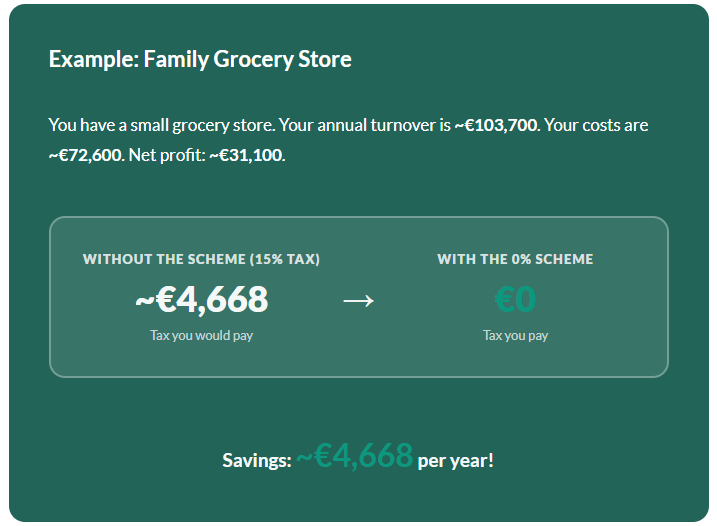
If your Albanian company earns under 14 million ALL in annual revenue, your corporate income tax bill is exactly zero.
That is roughly €145,000 in profit.
And it applies to SH.P.K. entities, sole proprietorships, and joint stock companies alike.
We break down exactly how to qualify in our Albania 0% corporate tax guide.
The 0% rule is automatic. You do not need to apply for it. But you must file annual financial statements by April 30 to maintain eligibility. Missing this deadline does not cancel the exemption, but it can delay your tax compliance certificate which you need for profit repatriation.
Now that you see the big picture, let us walk through each tax type, the thresholds that trigger them, and the compliance steps that keep you protected.
Corporate Tax: The 0% Rule Explained
Here is what most guides get wrong.
They make the 0% tax rule sound complicated.
It is not.
Albania designed this specifically to attract foreign investment.
And the eligibility is straightforward.
How The Threshold Works
Your Albanian company pays 0% corporate income tax on annual profit up to 14 million ALL.
That is approximately €145,000.
Once you cross that threshold, the rate jumps to a flat 15% on everything above it.
No brackets. No calculations. Just one clean cutoff.
For context, that is significantly lower than most European jurisdictions:
| Country | Effective Corporate Tax Rate |
|---|---|
| Albania (under threshold) | 0% |
| Albania (above threshold) | 15% |
| Germany | ~30% (CIT + trade tax) |
| Italy | ~24% (IRES) |
| Poland | 19% |
Who Qualifies For 0%?
Good news.
Almost every foreign-owned business structure qualifies:
- ✔ SH.P.K. (Limited Liability Company)
- ✔ Sole Proprietorships (Individual Entrepreneur)
- ✔ Joint Stock Companies (A.Sh.)
The key is your revenue level, not your corporate structure.
For complete details on thresholds and qualifications, see our 0% corporate tax guide.
What Counts As Revenue?
This is where founders get confused.
The 14 million ALL threshold applies to gross annual revenue, not profit.
So if your company invoices €150,000 in a fiscal year, you cross the threshold even if your actual profit is lower.
Plan accordingly.
If you are close to the limit, consider timing large invoices strategically across fiscal years.
You must submit annual financial statements by April 30 each year. This is mandatory even if you owe 0% tax. Missing this deadline does not cancel your exemption, but it can delay your Tax Compliance Certificate.
Dividend Tax: What Happens When You Take Profit Out?
Here is the next question everyone asks.
"I made profit. Now I want to pay myself. What do I owe?"
Albania charges a flat 8% dividend tax when you distribute profits to shareholders.
That is it.
No additional withholding. No surprise levies.
And if you reinvest profits back into the company instead of distributing them, you defer this tax indefinitely.
Many founders use this strategy to compound growth tax-free during the early scaling phase.
VAT Rules: When To Register And When To Wait
VAT is the second most misunderstood tax in Albania.
Some founders register too early.
Others wait too long and trigger penalties.
Here is how to get it right.
The VAT Threshold Explained
You are not required to register for VAT until your annual turnover exceeds 10 million ALL.
That is approximately €102,000.
Below this threshold, VAT registration is optional.
Above it, registration becomes mandatory within 30 days.
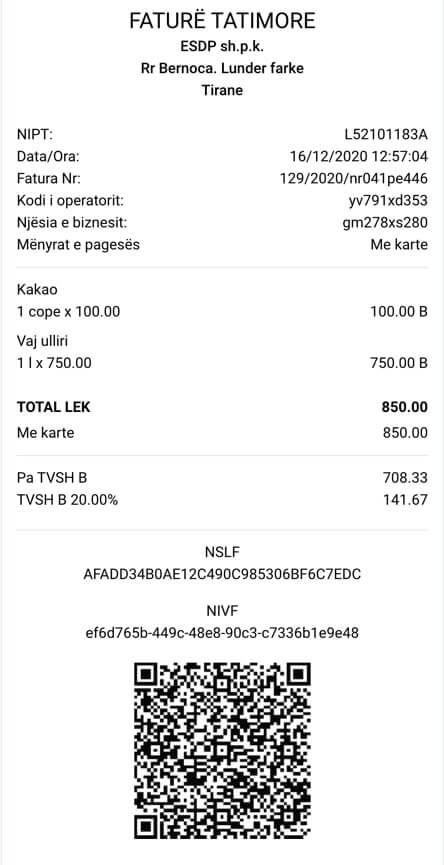
The standard VAT rate in Albania is 20%.
Should You Register Voluntarily?
Here is the strategic question.
If you are below the threshold, should you register anyway?
It depends on your client base:
- ✔ Register early if your clients are VAT-registered businesses. They can reclaim the VAT you charge, and you can reclaim VAT on your business expenses.
- ✘ Wait if your clients are consumers or non-VAT entities. Your prices become 20% higher with no benefit to them.
For digital agencies and consultants serving EU businesses, early registration often makes sense.
For local service businesses, waiting until mandatory is usually smarter.
If you register for VAT, you can reclaim VAT on business expenses: equipment, software subscriptions, office costs, and professional services. For startups with significant upfront costs, this can improve cash flow meaningfully.
Invoicing EU Clients: The Reverse Charge Rule
This is critical for service businesses.
If you provide services to EU-based businesses, the reverse charge mechanism typically applies.
What does this mean?
You invoice without Albanian VAT. Your EU client accounts for VAT in their own country.
Your invoice must include:
- ✔ Your Albanian NIPT (Tax ID)
- ✔ Your client's EU VAT number
- ✔ A clear note: "Reverse charge applies"
This keeps your invoices compliant and avoids double taxation.
For details on cross-border tax treatment, review our tax treaty guide.
VAT Filing Deadlines
Once registered, you must file VAT returns monthly.
The deadline is the 14th day of the following month.
Example: January VAT is due by February 14.
Missing VAT filing deadlines triggers automatic penalties. Even if you owe zero VAT for the period, you must still file. Late filing fines start at 5,000 ALL and increase with repeated violations.
When VAT Registration Makes Sense
Consider voluntary registration if:
- ✔ You have significant VAT-able business expenses
- ✔ Your clients are primarily VAT-registered businesses
- ✔ You expect to cross the threshold within 6 months
For complete threshold details and tax calculations, see our income tax guide.
Personal Tax & Social Contributions: What Directors Must Pay
Here is the hidden cost most founders miss.
Even if your company has zero employees, you still owe monthly social contributions.
Let me explain exactly what applies to you as a director.
Minimum Social Security For Administrators
Albanian law requires every company to have at least one Administrator.
That person must pay monthly social security and health contributions.
This applies even if:
- ✔ You have no other employees
- ✔ You pay yourself no salary
- ✔ You live outside Albania
The minimum monthly contribution is approximately 13,800 ALL or about €140 per month.
This is based on the current minimum wage calculation and is subject to annual adjustments.
Why This Matters For Your Exit Strategy
Here is what most guides do not tell you.
If you skip these payments, you cannot obtain a Tax Compliance Certificate later.
Without that certificate, you are legally blocked from:
- ✘ Repatriating profits to your home country
- ✘ Selling your company to a new owner
- ✘ Closing the company cleanly
Do not let a few missed months block your exit strategy years later.
Salary Tax: If You Pay Yourself
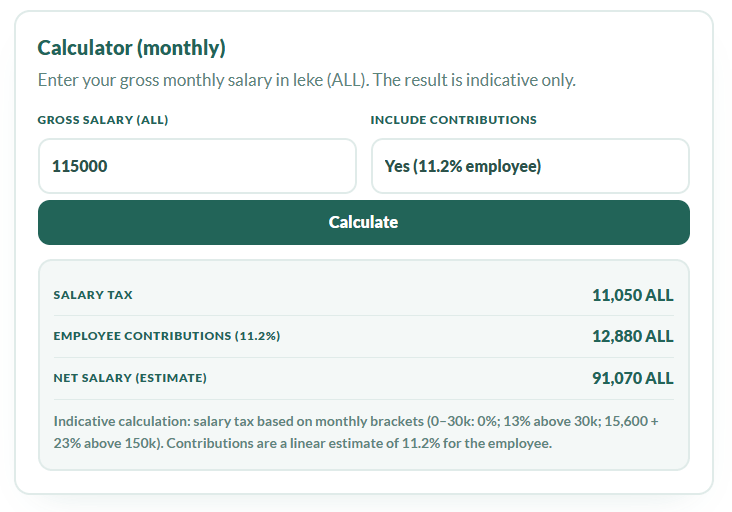
If you decide to pay yourself a formal salary from the company, additional taxes apply:
| Tax Type | Rate | Who Pays |
|---|---|---|
| Personal Income Tax | 0% to 23% (progressive) | Employee |
| Social Security | 9.5% | Employee |
| Health Insurance | 1.7% | Employee |
| Employer Social Security | 15% | Company |
Many foreign directors choose to pay themselves through dividends instead (8% flat tax) rather than salary.
This is legal and common for non-resident founders.
For early-stage companies, consider taking minimal salary to cover the mandatory social contributions, then distribute remaining profit as dividends at 8%. This often results in lower overall tax than a full salary package. Consult with a local accountant to model your specific situation.
Double Taxation: Will You Pay Twice?
This is a common concern.
"If I pay tax in Albania, do I also pay in my home country?"
It depends on your residency status and existing tax treaties.
Albania has double taxation agreements with over 40 countries including:
- ✔ Germany
- ✔ Italy
- ✔ Poland
- ✔ Greece
- ✔ Turkey
These treaties prevent you from paying full tax in both countries.
Typically, you pay in Albania first, then claim a credit in your home country.
For specific treaty details, see our tax treaty overview.
The Bottom Line On Personal Tax
Budget for these mandatory costs from day one:
- ✔ ~€140/month minimum social contributions for Administrator
- ✔ 8% dividend tax when you distribute profits
- ✔ 0% to 23% personal income tax if you take salary
These are predictable, manageable costs that keep your company compliant and your exit options open.
3 Costly Tax Mistakes Foreign Founders Make (And How to Avoid Them)
Let me share a quick reality check.
I have reviewed hundreds of tax files for foreign-owned Albanian companies.
The penalties almost never come from complex tax evasion schemes.
They come from simple, preventable paperwork errors.
Here are the 3 most common traps we see, and exactly how to steer clear of them.
Picking the Wrong NACE Code
Every company is registered under specific activity codes. Pick the wrong one, and you could accidentally trigger higher VAT requirements or miss out on industry-specific exemptions. Always align your codes with your primary revenue stream, not your secondary activities.
Missing VAT Filing Deadlines
VAT returns are due by the 14th of each month. Even if you owe zero VAT for the period, you must still file. Late filing fines start at 5,000 ALL and increase with repeated violations. Set calendar reminders. Or better yet, work with a local accountant who tracks this for you.
Skipping Social Security Payments
The €140/month administrator contribution is mandatory even with zero employees. Skip these payments, and you cannot get a Tax Compliance Certificate later. Without that certificate, you are legally blocked from repatriating profits or selling the company. Do not let a few missed months block your exit strategy.
The "Hidden" Monthly Cost You Must Budget For
Setting up the company is one thing. Keeping it compliant is another.
Most founders are surprised by the social security requirement.
Even if your company has zero employees, the government requires a monthly minimum social security and health contribution for the Administrator (Director).
This is approximately €140 per month or 13,800 ALL.
It is relatively small, but it is mandatory.
Why does this matter?
If you skip these payments, you cannot get a Tax Compliance Certificate later.
Without that certificate, you are legally blocked from:
- ✘ Repatriating profits to your home country
- ✘ Selling your company to a new owner
- ✘ Closing the company cleanly
Do not let a few missed months block your exit strategy years later.
The Bottom Line On Maintenance
Beyond taxes, you should budget for notarization, annual financial statements, and these monthly social contributions. We break down the exact company formation costs and setup packages so you can forecast your first year accurately.
Double Taxation Treaty Mistakes
Here is a sophisticated error we see often.
Founders assume they automatically qualify for double taxation relief.
They do not.
To claim treaty benefits, you must:
- ✔ Obtain a Tax Residence Certificate from your home country
- ✔ Submit it to Albanian tax authorities
- ✔ File correctly in both jurisdictions
Missing any step means you pay full tax in both countries.
For treaty specifics, review our tax treaty guide.
Compliance Sounds Heavy. Here Is The Reality.
On paper, this looks complicated.
In practice, it is just a checklist.
When you set up the right accounting workflow and keep your documents organized, it takes less than an hour a month.
The goal is simple: keep your company clean, your taxes predictable, and your focus entirely on growth.

Your Tax Compliance Calendar (And Next Steps)
You now have the full picture.
You know exactly how business taxes in Albania work for foreign entrepreneurs.
How the 0% rule applies to your company.
When VAT registration makes sense.
And which monthly contributions keep you compliant.
So, what is your actual next move?
It almost always falls into one of three paths. Pick the one that matches your current goal, and you will save weeks of research.
Complete Tax Deadline Calendar
Bookmark this. It is your compliance lifeline:
| Obligation | Frequency | Deadline |
|---|---|---|
| VAT Return | Monthly | 14th of following month |
| Social Security | Monthly | 15th of following month |
| Corporate Tax Payment | Quarterly | Within 40 days of quarter end |
| Annual Financial Statements | Yearly | April 30 |
| Corporate Tax Return | Yearly | April 30 |
Miss any of these, and penalties apply automatically.
Set calendar reminders. Or work with an accountant who tracks this for you.
You Need Full Tax Breakdown
If you want complete details on the 0% threshold and qualification rules, our 0% corporate tax guide breaks down every scenario step by step.
You Want Treaty Benefits
If you need to claim double taxation relief, review our tax treaty overview. It explains which countries qualify, required documentation, and how to file correctly in both jurisdictions.
You Need Setup Support
Looking for hands-on help with registration, tax ID, and compliance setup? Our company formation services handle the entire process from start to finish.
Before You File Your First Tax Return
Confirm your NACE code. This dictates your tax obligations and VAT status from day one.
Calculate your revenue threshold. Know if you are under or over the 14 million ALL corporate tax limit.
Set up monthly payment automation. The €140 social security contribution must be paid by the 15th each month without fail.
Calendar all filing deadlines. VAT (14th), Social Security (15th), Annual Statements (April 30). Missing these triggers automatic penalties.
Engage a local accountant. Albanian tax law changes. Having local expertise keeps you compliant as rules evolve.
Keep it simple. Track your deadlines. Pay on time. And file correctly.
Albania is not the most complicated tax jurisdiction in Europe. It just rewards founders who prepare correctly before they file.
You now have the blueprint.
The next step is execution.